
Table of Contents
If you trade through Dubai, one decision keeps returning: should you send goods by sea or by air? The city’s ports and airports — notably Jebel Ali Port, Port Rashid, Dubai International (DXB) and Al Maktoum (DWC) — connect your business to the world. But each mode has different costs, risks, lead-times and compliance quirks. This review explains the trade-offs in plain language, uses local (Dubai/GCC) context, and gives decision rules you can apply to your shipments right away.
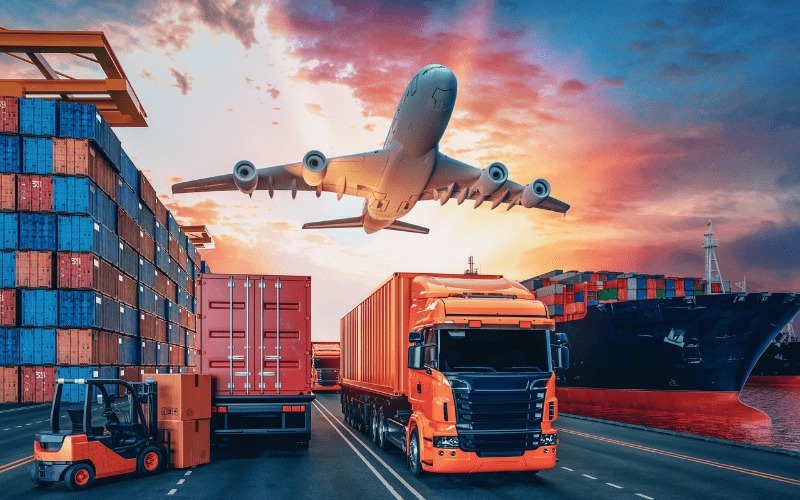
- If cost per kg and large volume matter → choose sea freight.
- If speed and time-sensitivity matter → choose air freight.
- For many businesses the pragmatic answer is hybrid: air for urgent SKUs, sea for bulk replenishment.
- Always check total landed cost (freight + duties + port fees + handling + storage), not just headline freight rates.
Scroll down for the full comparison, case studies, decision matrix and Dubai-specific tips.
| Metric | Sea Freight | Air Freight |
|---|---|---|
| Cost per kg | Low (best for large volume) | High (best for urgent/light cargo) |
| Speed | 7–45 days (depends on route) | 1–7 days (global) |
| Capacity | Very high (containers, bulk, RoRo) | Limited by aircraft space/weight |
| Reliability | High when scheduled well, but vulnerable to port congestion | High but affected by space restrictions/fuel surcharges |
| Documentation | Bill of Lading, customs, port handling | AWB, customs — faster clearance with AEO |
| Environmental footprint | Lower CO₂/ton-km | Higher CO₂/ton-km |
| Best for | Bulk, heavy, low-value, non-urgent | Perishable, urgent, high-value, small parcels |
Many companies pick by price only—this is a trap. Compare landed cost, which includes:
- Freight (sea or air rate)
- Terminal handling charges (port/airport fees)
- Customs duties and taxes (destination dependent)
- Inland transport (trucking to/from Jebel Ali or DXB)
- Insurance and packaging
- Storage / demurrage / warehousing
Example (illustrative): shipping 1,000 kg of electronics from Dubai to Accra
- Sea (LCL / shared container): freight lower (say AED X), but add container consolidation fees, port handling at Tema, inland trucking in Ghana. Total landed cost might be 30–60% lower than air for the same consignment, but transit takes longer (20–35 days).
- Air: freight per kg is much higher (AED Y/kg), customs clearance faster, but total cost can be 3–6x sea per shipment.
Decision rule: compute landed cost per unit and include inventory carrying cost (if you can’t stock, air may be cheaper despite higher freight).
- Air freight wins on speed: typical transit from Dubai to major hubs (Europe, Africa, USA) ranges from 1–5 days (excluding last-mile). For same-day or next-day critical shipments, air is often the only option.
- Sea freight is slower but once schedules are fixed, predictable. Transit times Dubai → West Africa or Europe vary by service but are generally 15–35 days.
Predictability nuance: air is faster but can suffer from flight cancellations, weight restrictions, and seasonal space crunches (e.g., peak retail seasons). Sea can be delayed by port congestion or vessel rotation changes. In 2025, digital tracking and predictive ETA tools have improved predictability for both modes — adopt providers that supply these tools.
- Sea freight: longer exposure to handling events (more touchpoints), risk of salt, moisture and stacking damage if not properly packed. But for standard cargo and with proper stuffing and insurance, claims are manageable.
- Air freight: fewer handling stages, reduced transit time → lower exposure to theft and damage. However, increased handling at transhipment airports is still a risk for certain goods.
Customs & AEO: Dubai’s AEO scheme and e-customs systems speed customs for compliant shippers. Using an AEO-certified forwarder (or working with one like NauticalGulf) reduces customs wait times whether you choose air or sea.
- Perishables, medicines, high-value electronics, fashion samples → Air (temperature control/priority handling).
- Vehicles, heavy machinery, furniture, consumer goods, bulk commodities → Sea (RoRo, FCL, bulk).
- Mixed SKU-based retail shipments → Hybrid: air for fast movers + sea for replenishment.
Case study (Dubai exporter): A Dubai clothing exporter moved new season samples by air to multiple buyers, while replenishment cartons travelled by sea in 40ft FCLs. Net result: faster market testing and lower replenishment costs.
- Jebel Ali (DP World) is the main sea gateway. It offers frequent feeder services—choose a forwarder with Jebel Ali slot expertise to avoid demurrage.
- Dubai International (DXB) handles high-value airfreight and perishables. Al Maktoum (DWC) is expanding for cargo and may offer lower airport fees for large consolidations.
- Free zones (JAFZA, DWC Free Zone) provide customs and VAT advantages; combine sea imports into free zone warehousing to defer duties.
- Peak seasons: plan ahead around Ramadan, summer holidays and year-end retail peaks — air space and vessel slots tighten.
- Sea freight typically emits less CO₂ per ton-km. If you must report Scope 3 emissions, prioritize sea freight for bulk goods and request emissions data from carriers.
- Some shipping lines and forwarders offer carbon offset options or lower-sulphur fuel (IMO 2020 / subsequent green fuel adoption). Air freight offsets are available but costlier.
- Buyers and retailers increasingly prefer suppliers who can demonstrate greener logistics — a commercial reason to favor sea when feasible.
- Real-time tracking: GPS, IoT sensors (temperature/humidity), and port APIs deliver near-real-time ETAs for containers and air cargo shipments.
- Predictive analytics: helps anticipate port delays or flight disruptions; route re-planning is possible if you work with forwarders who offer these tools.
- Documentation: eB/L (electronic Bill of Lading) and eAWB streamline handovers. For Dubai-based shippers, using a forwarder integrated with Dubai Trade or DP World portals reduces paperwork delays.
Review tip: pick a forwarder that gives a single dashboard for both sea and air shipments—this simplifies hybrid logistics.
- Situation: 500 kg of high-value electronics, weekly schedule.
- Approach: small urgent batches by air for launch; main inventory by sea FCL monthly.
- Outcome: launch on time, inventory replenished at 45% lower landed cost vs all-air shipping.
- Situation: spare parts required quickly in West Africa.
- Approach: parts flown to Dubai consolidation hub; shipped by sea in consolidated containers to West African ports.
- Outcome: reduced total lead time vs direct sea (because of better flight frequency to DXB) and lower cost than fully air.
- Situation: high volume garments for Ramadan/holiday.
- Approach: pre-book sea space 8 weeks earlier, use express air shipments for last-minute shortages.
- Outcome: minimized stockouts, lower emergency air shipments, optimized inventory holding.
- Hidden surcharges: BAF (bunker), CSC (container service charge), THC (terminal handling), Peak Season Surcharges — ask for a fully itemized quote.
- Demurrage and detention: If you can’t pick up containers within free time, fees stack quickly. Plan inland logistics in Dubai in advance.
- Documentation fees: some forwarders add admin or scanning fees. Negotiate these upfront.
- Insurance gaps: basic carrier liability is limited — purchase all-risk marine or air cargo insurance if value is high.
Smart tip: demand a landed cost estimate for both sea and air options before deciding.
- Is the cargo time-sensitive? → Yes → Air
- Is the cargo heavy or large volume? → Yes → Sea
- Is the unit value high and damage-sensitive? → Consider Container (Sea) or Premium Air with temperature control
- Do you need lower emissions footprint? → Sea (or hybrid)
- Is total landed cost the primary KP I? → Compute landed cost; pick the cheaper method that meets delivery windows
- Best for Cost Efficiency: Sea freight via FCL (Rank: ★★★★★)
- Best for Speed: Air freight express (Rank: ★★★★★)
- Best for Flexibility: Forwarders offering hybrid solutions and consolidated cargo (Rank: ★★★★☆)
- Best for Sustainability: Sea (Rank: ★★★★★)
- Best for Low Risk / High Value: Containerized sea with insurance or premium air (Rank: ★★★★☆)
- Check license & AEO status.
- Confirm port/airport relationships (Jebel Ali, DP World, DXB cargo).
- Request API access or portal login for tracking.
- Ask for landed cost calculation for both modes.
- Verify insurance limits and cargo packaging standards.
- Discuss peak season planning and contingency routing.
- Confirm incoterms (FOB, CIF, DAP) and who pays which costs.
- If you’re cost-driven and can plan inventory: sea freight from Dubai via Jebel Ali remains the smart choice.
- If speed matters and the goods are time-sensitive or high value: air freight via DXB or DWC.
- If you want balance between speed, cost and risk, use hybrid strategies and work with an AEO-certified, tech-enabled forwarder that handles both seamlessly.
Local expertise in Dubai reduces friction: faster customs clearance, better negotiation with shipping lines, and real knowledge of Jebel Ali operational idiosyncrasies. An experienced forwarder helps you choose sea vs air correctly, manage documentation, and keep landed costs low.
If you want a partner who understands both sides of the equation — marine & air — and offers modern tools (real-time dashboards, AEO-compliant clearance, hybrid routing and proactive re-routing), consider working with a specialist like NauticalGulf. They combine Dubai hub expertise, transparent landed-cost quotes, and hybrid shipping strategies to match business goals with the right transport mode.
Q: Is sea freight always cheaper than air from Dubai?
A: On a per-kg basis and for large volume, yes. But always compare landed cost and inventory carrying cost.
Q: How long is sea freight from Dubai to West Africa?
A: Generally 15–35 days depending on the service and transhipment stops.
Q: What is FCL vs LCL?
A: FCL = Full Container Load; LCL = Less-than-Container Load (consolidated).
Q: Can I mix air and sea in the same supply plan?
A: Yes — hybrid plans are common: air for urgent SKUs, sea for replenishment.
Q: How do Dubai’s ports compare?
A: Jebel Ali is the main deep-sea hub; Port Rashid handles niche operations; DWC is expanding air-cargo capacity.
